Tuesday, January 21, 2014

Tactical Analysis: West Brom 1-1 Everton

Diego Lugano headed in a second half equalizer to give Pepe Mel a 1-1 draw with Everton in his first game as West Brom manager. Lugano was an unlikely hero- he had been largely responsible for Everton's opener after his slow reaction to a Romelu Lukaku flicked header left Kevin Mirallas through on goal to finish with ease.

It was a strange contest with few clear cut scoring opportunities. Everton were a far cry from the energetic, attacking side they've become known for under Roberto Martinez and West Brom didn't have the quality in the attacking third to offer a consistent goal scoring threat.

Martinez went with his usual 4-2-3-1. Ross Barkley remains sidelined with a broken toe and Steven Pienaar missed out with a groin injury so Martinez had to do some shuffling with his three attacking midfielders. Kevin Mirallas played through the middle, Leon Osman played on the left and Brian Oviedo on the right.

Mel opted for a 4-4-2 in his first game in charge. Matej Vydra partnered Nicolas Anelka up front. James Morrison was chosen ahead of Youssuf Mulumbu to partner Claudio Yacob in the middle of midfield. They were flanked by Christ Brunt on the left and Zoltan Gera on the right. Gareth McAuley was unable to recover in time from a hamstring injury and was replaced by Lugano at center back.


Probably the most interesting tactical feature of the first half was West Brom's pressing in midfield. They defended in banks of four. Morrison and Yacob would immediately close down Gareth Barry and James McCarthy when they received the ball in deep positions in midfield. Behind them, Olsson and Lugano would stick tight to the backs of Lukaku and Mirallas and follow them when they tried to drop off into midfield to find space. The midfield pressing limited the amount of time Barry and McCarthy had on the ball and forced them into making backwards and sideways passes. They struggled to play penetrating passes into the front four and as a result the pace of Everton's passing moves was much slower than we're used to seeing.


That Everton's goal came from an uncharacteristically direct move was in part due to West Brom's pressing. Martinez's side had been struggling to transition from the midfield to the attacking third when Sylvain Distin bypassed the midfield altogether and clipped a long ball into Lukaku making a diagonal run. Here, West Brom's tactics hurt them. Because Morrison and Yacob were pressing Barry and McCarthy in midfield, it meant neither were available to pick up the #10 Mirallas in between the lines. As a result, one of the two West Brom center backs had to step out and stick tight to him rather than tucking in and providing cover on Lukaku. The screen shots below show the sequence leading up to the goal. Lugano steps forward to get tight on the back of Mirallas while Olsson marks Lukaku (image 1). Lukaku makes a diagonal run in behind Lugano, forcing Olsson away from his left center back position towards the right channel, leaving an ocean of space through the middle of the pitch (image 2). Lukaku flicks a header on into that space and Mirallas spins off Lugano and beats him in behind for pace. Without a spare center back to provide cover it was an easy finish for Mirallas.

Image 1: Lugano and Olsson tight to Mirallas and Lukaku
Image 2: Olsson forced to track Lukaku's run towards right channel, Mirallas sprints into space left open in behind
West Brom's primary attacking approach in the first half was through the channels. Both Everton fullbacks Seamus Coleman and Leighton Baines are encouraged to provide width high up the pitch when Everton are in possession, thus leaving space in behind them for the opposition to counter into. Anelka would quickly drift wide into this space when West Brom won the ball back and receive outlet passes in the channels. He'd look for Vydra or one of the midfielders breaking forward but too often West Brom's passing was sloppy on the break and they couldn't take advantage of some favorable positions in wide areas.

Mel changes to 4-2-3-1
They key to West Brom getting back in the game was Mel's change in shape to 4-2-3-1 after he introduced Mulumbu for Gera in the 60th minute. Mulumbu played in midfield alongside Yacob, allowing Morrison to move into an advanced #10 position behind Victor Anichebe who had come on at half for Vydra. Anelka moved to the right wing. The shift to three in central midfield allowed West Brom to more comfortably keep possession in attacking areas. Morrison provided the link forward that had been missing when the shape was 4-4-2. West Brom had completed 56 passes in the attacking third in the first hour of play before the change. They completed 45 attacking third passes in the 30 minutes after it, a spell that saw them get an equalizer and close out the contest looking the more likely to find a winner.


Conclusion
The 1-1 result was fair as neither side did enough to win this. Despite looking less than their best Everton were the better side in the first half. West Brom improved in the second half and Mel deserves credit for the impact his switch from 4-4-2 to 4-2-3-1 had on the balance of play.

Sunday, January 19, 2014

United's defensive lapses result in comfortable Chelsea win

With Wayne Rooney and Robin Van Persie sidelined with injuries, it was always going to be important Manchester United limited defensive errors in order to have a shot at getting a result at Chelsea. Moyes would have expected goals to be tough to come by on the road against a team led by Jose Mourinho- a manager who is historically cautious in big games. Going behind would force United to open themselves up to get back in the contest against a Chelsea side comfortable defending for long stretches of time and playing on the counter. That Chelsea's second and third goals were the result of criminally poor defending from corner kicks meant the home side never really had to kick into their highest gear and play particularly well.

Moyes' side started brightly, particularly attacking down the channels. The fullbacks Evra and Rafael overlapped Young and Valencia well forcing Chelsea's wide attackers Hazard and Willian to defend deep in their own half. Januzaj drifted towards the left channel from his starting #10 position to create overloads on Ivanovic. Although United were unable to translate their early pressure into genuinely threatening opportunities, they were at least keeping Chelsea's dangerous attacking midfielders pinned into their own half.


Samuel Eto'o's opener came against the run of play and took a fortunate deflection. It was certainly a blow to the visitors but wasn't reflective of poor play from United. Chelsea asserted a bit more control after taking the lead but United showed attacking endeavor of their own creating a few decent half chances that indicated the contest was far from over. On 28 minutes Evra put a shot just wide of Cech's front post. Moments later Januzaj beat David Luiz to the end line but his cut back just eluded Welbeck lurking in the box. Then in the 38th Januzaj found Welbeck free 8 yards from goal but Azpilicueta did just enough to put him off, the shot rolling tamely into Cech's arms.

The game hinged on United's shockingly poor defending from a 45th minute Chelsea corner. Welbeck dealt with the initial ball in but it fell to Ramires outside the penalty area. United's players stepped forward collectively- as they should- but none actually bothered to check the Chelsea runners. Ramires played an easy ball to an unmarked Gary Cahill on the right edge of the box whose ball across the face of goal was easily poked in by Eto'o. Rafael was in the best position to step towards Cahill but inexplicably drifts into a more central area at the crucial moment.

From there it was game over. Chelsea were able to keep a compact organized shape at the back and attack with their front four, leaving Luiz and Ramires to sit in front of the back four and prevent United from countering. Chelsea under Mourinho have traditionally been excellent at protecting leads. United didn't have the creativity or quality in the attacking third to offer a serious threat. When Chelsea's third came from another display of poor set piece defending, any shred of doubt was lifted as to who the points were going to.

The result will of course increase pressure on Moyes. What he'll find so frustrating is that his thin squad didn't play badly for long stretches. Mistakes meant Chelsea didn't have to work as hard for the points as they probably should have based on the balance of play.

On the other side, Mourinho will be well pleased. He got three goals from a striker and his side were professional and ruthless. This had the hint of a Mourinho game under his first spell in charge at the club and his side are looking increasingly difficult to beat at the right time of the season.

Saturday, January 18, 2014

First half 4-4-2 leaves Liverpool too stretched in midfield

Brendan Rodgers's decision to play a 4-4-2 in Liverpool's 2-2 draw with Aston Villa this afternoon was an interesting one. Rodgers would have been well aware Paul Lambert's Villa nearly always play with three in the middle of midfield so would have known his team would be outmanned in that area.

From the opening whistle Liverpool were stretched in the midfield zone. Jordan Henderson partnered Steven Gerrard at center midfield. The two tried to get forward in possession to offer support in attacking areas. However, when Liverpool lost possession, they were out of position to offer protection for the back four and Villa were able to break uncontested through the middle.

Villa set out in a 4-1-2-1-2 shape with Andy Weimann playing at the top of the diamond just behind the front two of Christian Benteke and Gabriel Agbonlahor. Ashley Westwood sat just in front of the back four with Karim El Ahmadi and Fabian Delph on either side of him as box to box runners. The diamond midfield meant Gerrard and Henderson were often outnumbered 2 v. 4 in the middle of the pitch. When Villa won the ball back they were able to play easy outlet passes into Weimann or Benteke dropping in off the Liverpool center backs. They would then look to play penetrating balls to Agbonlahor running in the channels in the space behind Liverpool's advanced fullbacks. For Villa's opener Benteke provided the outlet pass for Delph and found Agbonlahor racing down the left sideline. Agbonlahor found Weimann in the box with a well weighted ball in for the goal.

Starting XI's: Liverpool 4-4-2; Villa 4-1-2-1-2
Liverpool's 4-4-2 shape also wasn't offering enough going forward. Although Coutinho tried to tuck inside from a starting left position to link play with the two forwards, it was easy for Villa to defend. Delph and El Ahmadi could apply pressure to Gerrard and Henderson while Westwood sat in the space between the lines to check Coutinho's runs inside or Suarez and Sturridge dropping in off the center backs. As a result, Liverpool struggled to get into the same sort of passing high up the pitch they're used to at Anfield.

Rodgers recognized the weakness of having just two center midfielders on and made an important change at halftime by bringing on Lucas. Rather than subbing off one of his center forwards in order to add Lucas as a third midfielder, Rodgers instead took off Coutinho. Lucas sat in front of the back four, providing both protection for the back four when Villa countered and an extra passing option in midfield. Replacing a left sided attacking midfielder with a center midfielder meant Liverpool ran the risk of not having an attacker in advanced areas wide on the left. Their solution for this problem was clever. Aly Cissokho switched from a left fullback to a much more advanced left wing back. With Raheem Sterling providing natural attacking width on the right, Glen Johnson was able to sit deeper alongside Martin Skrtel and Kolo Toure as part of a back three. Liverpool's shape in possession was therefore more or less a slightly titled 3-5-2. Defensively Cissokho would drop back in to form a back four.

Liverpool shape in second half when in possession
The introduction of Lucas allowed Liverpool to assert more control on the game and left them less vulnerable on the counter. The Brazilian was forced off with an injury in the 66th minute and was replaced in a like-for-like sub with Joe Allen. Allen didn't offer quite the same sturdy platform for Gerrard and Henderson to get forward that Lucas did and at times Liverpool looked uncertain at the back. The game surprisingly fizzled out a bit after Gerrard equalized from the penalty spot. Villa deserve credit for not allowing the home side to take control of the contest after that goal.

Tactical Analysis: Sunderland 2-2 Southampton

Sunderland clawed their way back to earn a 2-2 draw after falling two goals behind in a first half dominated by the visiting Saints. Mauricio Pochettino's side controlled the tempo in the opening half with nearly 70% possession and created a slew of decent chances. However, despite being far less fluid than the visitors in the final third, Sunderland fought back in the second half by pressing Southampton further up the pitch and hurrying them in possession.

Pochettino used a sort of fusion 4-3-3/4-2-3-1 with Steven Davis playing deeper and more narrow than a typical right sided attacking midfielder. Adam Lallana was in the #10 spot behind Rickie Lambert. Victor Wanyama was unable to recover from a calf injury in time so Jack Cork was given the nod alongside Morgan Schneiderlin in midfield.

Gus Poyet opted for his standard 4-3-3. Lee Cattermole sat in front of the back four with Seb Larsson and Ki on either side of him as midfield shuttlers. Jozy Altidore was given the start at striker ahead of Steven Fletcher.


From the start of the match Sunderland defended in a 4-1-4-1 shape with Cattermole sitting in between the defensive and midfield four tracking the movement of Lallana in between the lines. The key to Southampton's first half possession dominance was the positioning of Steven Davis. Although he was listed as the right sided player in Southampton's attacking midfield three, he actually took up a deep and narrow position alongside Schneiderlin and Cork. This meant that when Ki and Larsson tried to press Cork and Schneiderlin respectively, Southampton always had Davis free in midfield to receive a pass and as a result Southampton were able to keep attacking moves going without being forced into hitting long hopeful balls forward. The graphic below shows where Davis received passes in the first half and all of his first half passes. Noticed he received passes throughout the deep midfield zone as Southampton's spare midfielder, not just on the right side.


Southampton's goals were a result of their possession dominance. Sunderland were pinned in their own half and when they did win the ball back they were too deep to find an outlet ball and maintain a bit of possession of their own. With all three Sunderland midfielders and the two wide forwards forced to defend deep in their own half, the only option was to lump the ball long towards Altidore when they won possession. He was an isolated figure up front and needed to hold the ball up long enough to bring the midfield runners into play. It was always going to be a difficult and thankless task but the American didn't perform it well enough given his size and strength. Too often his first touch and passing accuracy let him down. He completed just 2 of 9 passes in the attacking third in the first half.

For the opener the Black Cats failed to clear their lines in their own penalty area as they defended frantically. The ball fell for Jay Rodriguez at the top of the box and he dispatched his effort brilliantly. Rodriguez probably should have doubled his tally moments later when Lambert played him through but Vitto Mannone saved his effort towards the back post. When the Saints eventually did get their second through an excellently taken Jose Fonte volley off a corner the lead was no more than they deserved.

Pochettino therefore would have been bitterly disappointed to have conceded so quickly after on Sunderland's only sniff of a chance in the first half (they finished the half with just two shots, the goal the only one on target). Johnson did well to spot Borini's diagonal outside to inside run. Calum Chambers appeared to have done well to recover into a good position to get a block on but Borini cut his shot back across goal into the far corner.

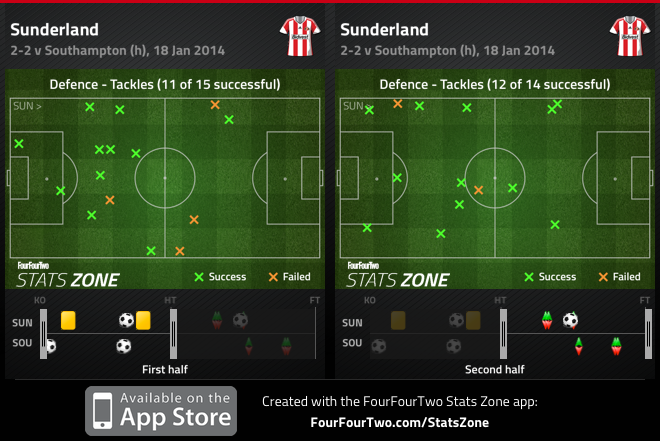
The goal appeared to ignite Poyet's side and the home crowd going into the second half. Although Southampton created dangerous opportunities on the break in the opening 15 minutes of the half, Sunderland offered more of a threat themselves going forward. The key to Sunderland getting back into the contest was their work rate in pressing Southampton in midfield. The visitors didn't enjoy the same time on the ball that they did in the first half and as a result lost possession deeper in midfield. By winning the ball back higher up the pitch, Sunderland had the advantage of both having more players in positions to get forward and Southampton having less time to recover into a decent defensive shape. The additions of Jack Colback and Craig Gardner in the midfield in place of Cattermole and Larsson gave Poyet's side some fresh legs and added energy. The graphics below shows Sunderland winning tackles and interceptions in much more advanced areas in the second half.

Sunderland tackles: first half (left) vs. second half (right)

Sunderland interceptions: first half (left) vs. second half (right)
Johnson's equalizer probably should have been saved by Arthur Boruc but it came at a time when Sunderland were on the ascendency thanks to their pressing.

The contest could roughly be described as one between two very different styles of play. Sunderland's focus was on organization, work rate and quick vertical moves forward while Southampton emphasized possession and patient build up from the back. The visitors were more fluid in attack- their play in the first half was highly impressive- but Poyet's side deserve credit for the commitment they showed after going behind. Whether passion and work rate will be enough to keep them in the Premier League remains to be seen.

Sunday, January 12, 2014

Liverpool beat Stoke in wild contest defined by errors

Liverpool moved back into the top four with a 5-3 win over Stoke in a game that was shockingly sloppy but entertaining. Team tactics played a minor role- the defining feature of the contest was individual errors. Four of the game's goals could be blamed at least partially on individual mistakes- Liverpool's second was the result of errors from Mark Wilson and Ryan Shawcross, Stoke's second came from a poor giveaway by Jordan Henderson, Liverpool's third came from a Wilson giveaway and Stoke's third came after a poor touch from Steven Gerrard gifted Marko Arnautovic possession down the left wing. A fifth goal resulted from an unfortunate Shawcross own goal from an Aly Cissokho shot that was going well wide.

The most obvious tactical features were Stoke's pressing in midfield and their attacks down the channels that culminated in crosses into the box. In the first half Charlie Adam drifted to the right from his #10 role and Stoke looked to overload Cissokho with Adam, Jonathan Walters and Geoff Cameron overlapping from his right back spot. The graphic below shows how heavily Stoke favored attacks down the right in the opening half. The left side of the screen shows Stoke's attacking third passes, the right side shows crosses.


It was interesting then that the home side's opener came from a rare foray down the left when Arnautovic provided a well weighted cross into Peter Crouch from the left wing.

Stoke looked to press Liverpool in midfield quickly closing down Gerrard and Lucas when they got the ball in deep positions. At the beginning of the first half Liverpool seemed to be dealing comfortably with the pressure- they found spaces between the Stoke lines to play balls into Coutinho and Henderson, easily bypassing the Stoke midfield. However, as the half wore on the visitors became increasingly sloppy in possession, a fact Brendan Rodgers will likely be especially frustrated by. At 2-0 up his side had the opportunity to take control of the game and dictate the tempo. Instead they were put off by Stoke's pressing and the match became frantic. Too often Liverpool gave away possession high up the field, allowing Stoke to break forward at an underprotected defense. The graphic below shows Stoke's 17 interceptions, 7 of which occurred in Liverpool's defensive half and the bulk of which occurred in the middle third of the pitch. By comparison Liverpool's interceptions occurred in deeper areas. They had just 2 interceptions in the attacking half, one of which resulted in Sterling winning a penalty.


When in possession Stoke looked to get the ball into the channels and hit crosses into the box towards Crouch. They won 11 corners and played a remarkable 51 crosses.  

Rodgers' side was at its most dangerous on the break, particularly after the introduction of Daniel Sturridge. With Sturridge on, Liverpool had three players in Sturridge, Henderson and Raheem Sterling with the energy and pace to be dangerous on the break. For Liverpool's fourth Sturridge received an outlet pass and was able to break through the middle at pace on the counter before cleverly laying off to Suarez to tuck home. Those two players would ultimately prove the difference makers in the contest as they combined yet again for Liverpool's fifth, this time with Suarez turning provider on the break for Sturridge.

In the end this was a stereotypical English game. It was low on technical quality and poise on the ball, high on energy and commitment. The match tape won't be used by youth coaches as an example of polished, intelligent football but it did make for an entertaining spectacle for those of us that can appreciate a sloppy goalfest every now and then.

Saturday, January 11, 2014

Tactical Analysis: Chelsea 2-0 Hull City

Chelsea managed to overcome a well organized Hull City side with second half strikes from Eden Hazard and Fernando Torres after Steve Bruce's side had frustrated the visiting Blues throughout the first half.

Bruce went with the 3-5-1-1 formation he's opted for most of the season with Ahmed Elmohamady and Maynor Figueroa operating as wing backs. George Boyd played a withdrawn forward role in behind Yannick Sagbo.Tom Huddlestone, David Meyler and Jake Livermore made up the midfield three.


Defensively, Hull's shape was almost a 4-5-1 despite the fact they lined up with three central defenders. Boyd would drop in on the left side of midfield to pick up Cesar Azpilicueta with Figueroa sitting in behind more as a traditional left back. On the other side Elmohamady defended higher up the pitch on Ashley Cole as part of the midfield bank of five. Behind him James Chester would close down the right flank from his right center back spot if any balls got in behind Elmohamady. The graphic below roughly shows Hull's shape.


Coming up against a midfield bank of five and three narrow center backs in behind them, Chelsea found it incredibly difficult to get any sort of penetration through the middle of the pitch. Mourinho played his normal 4-2-3-1 with David Luiz and Ramires as the double pivot and Oscar in the #10 role. Hulls shape was good and there weren't gaps available for Luiz and Ramires to play balls through the Hull midfield into Oscar and Hazard and Willian tucking inside from the wings. As a result, Chelsea were unable to get at the three Hull center backs. The screen shot below shows how compact Hull were and how crowded the center of the pitch was for Chelsea. All 11 Hull players are in the defensive half and the midfield five are working hard to deny Chelsea space in between the lines.


On a few occasions Luiz looked to bypass the Hull midfield with balls over the top into the channels but the three center backs were usually able to deal with them comfortably.

When Chelsea's opener finally arrived it was a result of brilliant build up play from the Blues and an excellent finish from Hazard rather than a loss of defensive shape from City. Ashley Cole got into an advanced narrow position, rare for him under Mourinho, and played a clever flick onto Hazard at the edge of the box. He was able to create enough space for himself to fire low past McGregor into the right corner of the net.

After the goal Hull ultimately shifted to a 4-4-2 but never really troubled Chelsea. With the home side forced to take a more adventurous approach, Chelsea had more opportunities to transition forward quickly on the counter. Torres sealed the win for Chelsea in the 87th from a two pass Chelsea move on the break.

Tuesday, January 7, 2014

Deep line, 2 man midfield leave Spurs too open in defeat to Arsenal

During his spells at both Chelsea and Tottenham, Andre Villas Boas was rather unyielding in his use of a high defensive line despite not having the ideal personnel to suit such a system. In late October 2011, Villas Boas's Chelsea were ripped apart 5-3 by Arsenal as the Gunners were continually able to run onto the ball in space behind Chelsea's high line. Chelsea's center backs that afternoon were Branislav Ivanovic and John Terry, two defenders more comfortable defending deep and dealing with crosses into the box than playing high and making recovery runs when balls are played in behind them.

Early in this season Arsenal again made Villas Boas pay for his stubborn insistence on a high line, this time as Spurs boss, in a 1-0 league win at the Emirates. In that contest Theo Walcott tucked in to a narrow position from the right and continually ran in behind the high line of Jan Vertonghen and Michael Dawson. The high line was once again at least partly at fault for the heavy winter defeats to Manchester City (6-0) and Liverpool (5-0) that would ultimately cost Villas Boas his job.

It comes as little surprise then that Villas Boas's replacement Tim Sherwood has adopted a deeper defensive line to keep the opposition from getting in behind his back four, a strategy he stuck with in Saturday's FA Cup tie with Arsenal. Spurs captain and center back Michael Dawson is particularly ill-suited to play a high line and with Theo Walcott employed as the striker for the Gunners, a deeper line meant fewer opportunities for Arsenal's pacey England international to get on the end of through balls and run at Hugo Lloris 1 v 1.

While the deeper positioning may have mitigated the danger behind Spurs back four, it left far too much space between the midfield and defensive lines for Arsenal to exploit. These large gaps between defense and midfield could have been at least partly remedied while still sticking with a deep defensive line in one of two ways: Sherwood could have opted away from the 4-4-2 he's gone with since taking over and pulled a striker in place of a third center midfielder or, having decided to use a 4-4-2, he could have gone with a positionally disciplined, physical holding midfielder. With Sandro unavailable the obvious choice was Etienne Capoue.

As it turned out Sherwood went with Nabil Bentaleb and Moussa Dembele. Both players shuttled high up the pitch when Spurs were in possession, leaving large gaps between themselves and their center backs. Without a third center midfielder to plug the space by sitting deeper in front of the back four, Arsenal were able to quickly transition on the break into the huge amounts of space behind Bentaleb and Dembele and run at center backs Dawson and Chiriches.

Whether you play a high line or a deep one it's crucial that your defensive shape is compact and you leave minimal space between the lines. If Spurs were going to play a deeper line, their central midfielders needed to play deeper as well. This is particularly important against a team like Arsenal who boast a wealth of players skilled at playing in pockets of space between the lines. In this contest Tomas Rosicky, playing the #10 role, and Santi Cazorla and Serge Gnabry, tucking inside from the channels, were all able to collect the ball in space behind the Tottenham midfielders.

The two screen shots below show the buildup to Cazorla's opener. The first image shows the gap between Bentaleb, Spurs deeper center midfielder, and the center backs just prior to Bacary Sagna's simple penetrating ball into Gnabry in space between the lines (the ball is at Sagna's feet in the image who is hidden behind the Macclesfield v. Sheffield Wednesday score). Keep in mind Arsenal are not quickly countering here with Spurs racing to get back- they've had the ball for 8 seconds at this point, giving Bentaleb and Dembele time to get closer to their center backs.


This next image shows Gnabry receiving Sagna's pass. Gnabry is able to comfortably receive the ball in the vast space between Tottenham's defense and midfield while Bentaleb is completely taken out of the play with the Sagna's pass. Gnabry sprints inside forcing both Chiriches and Dawson to step and lays a pass wide to the left for Cazorla to finish. Had Spurs been more compact with a holding midfielder in front of the center backs, that holding midfielder could have stepped to Gnabry, allowing Dawson to check Cazorla's run inside.


The opening goal wasn't an isolated incident of Spurs leaving too much space in front of the back four. Prior to that Rosicky twice found himself in space behind the Spurs midfield and played penetrating passes into Walcott to set up dangerous opportunities. Chiriches made a last ditch block on the first one and Lloris stood his ground well at the front post on the second but Tottenham's weakness was obvious (you can see both chances in the highlights below).


The screen shot below shows another example. The gap here between Chiriches-Dawson and Dembele-Bentaleb is startling. Both Wilshere and Rosicky are in dangerous positions to receive the ball between the lines and cause the center backs problems. On this occasion Wilshere took a poor first touch and conceded possession but the goal would come shortly after.


Playing 4-4-2 against Arsenal is always going to be a substantial risk. Arsene Wenger's side are quite good at tucking their wide attacking midfielders inside and overwhelming the opposition in central areas. With Arsenal playing a 4-2-3-1 in this game and Cazorla often coming inside from the left, Arsenal at times had a 4 v. 2 advantage in the middle of midfield. If 4-4-2 was likely to work for Spurs, Sherwood needed his side to defend in tight, compact banks of four with one of either Soldado or Adebayor dropping in to put pressure on Arsenal's double pivot midfielders Wilshere and Mikel Arteta. As it played out, it was often Dembele and Bentaleb pressing Arsenal's two deep midfielders high in midfield, leaving space behind for the likes of Rosicky, Cazorla and Gnabry.

Many had questioned Sherwood's tactical acumen when he was appointed Spurs manager for the season. The sound defeat Saturday and his denial afterwards that his side were overwhelmed in midfield, or that they were even using a 4-4-2, will do little to quell those opinions.

Saturday, December 7, 2013

Manchester United lack invention in final third; Mourinho gets subs wrong

Johan Cabaye's second half winner handed Manchester United a second successive home league defeat for the first time since 2002 and earned Newcastle their first win at Old Trafford since 1972. It is David Moyes third home defeat of the season. Manchester United have scored just 8 goals at Old Trafford, fewer home goals than both West Brom and bottom of the table Sunderland.

The problems today against Newcastle were familiar ones. Moyes' side lacked the invention and quality in the final third to break down an organized opponent.

With Wayne Rooney missing due to yellow card accumulation, Moyes opted for a 4-4-2 with a front pairing of Robin Van Persie and Javier Hernandez. Tom Cleverley and Phil Jones played in the middle of midfield with Nani on the left wing and Adnan Januzaj on the right.

Alan Pardew opted for a 4-2-3-1 giving Newcastle a man advantage in midfield. The visitors were able to use that advantage to control the game in the middle of the park. With Cheikh Tiote and Vurnon Anita protecting the back four, Manchester United's forays into the final third occurred in the channels and mainly throught Januzaj down the right. Newcastle's center backs Mike Williamson and Fabricio Coloccini dealt with balls into the box from wide areas excellently and deserve a credit for their positioning.

Manchester United's inability to link play forward through the middle had plenty to do with the absence of Rooney. Van Persie lacked Rooney's energy and determination to get on the ball in the withdrawn striker role. Van Persie also lacks Rooney's directness dribbling through midfield. He attempted just one take on in the match. Playing Van Persie in the withdrawn role also meant he rarely found himself in the box where he's at his most dangerous. He didn't manage a single attempt on goal, an incredible stat for last season's Premier League leading goal scorer, and completed just 7 passes in the attacking third.


In the middle of midfield Jones and Cleverley didn't have particularly bad games. Indeed Jones was at times excellent with his defensive positioning and ability to protect the back four. However, both players are limited in what they can contribute in the attack and couldn't have been expected to provide the impetus or creativity going forward to create chances. As a result their roles in possession mainly involved funneling the ball into wide areas where the outside backs would look to overlap Nani and Januzaj tucking inside- another factor that contributed to their inability to vary their attacking approach and penetrate Newcastle through the middle of the pitch. You can see in the graphic below the number of horizontal passes into wide areas both Manchester United center midfielders made.


The extra midfielder also allowed Newcastle to control possession. They ended the contest with 54% possession, a slight but significant edge given they were an inferior team in terms of talent playing at the home of the league champions. Their goal was perhaps a bit opportunistic but Pardew's side deserves immense credit for their organization. The three center midfielders Anita, Tiote and Cabaye were all commanding in the middle of the pitch and the back four organized itself with aplomb. The performances of Debuchy and Williamson in particular deserve recognition. Debuchy was a menace getting forward from his right back position but he also had the pace and energy to make recovery runs.

Mourinho's move to 4-4-2 costly again
Stoke City shocked Chelsea with a 3-2 home win after being completely overrun for the first 40 minutes. For the third time this week Jose Mourinho's side allowed an opposition corner to bounce in the box without getting a touch on it and each time they were made to pay with a goal. John O'Shea and Phil Bardsley were able to tuck in from close range Wednesday for Sunderland, today Crouch scored in a similar fashion for Stoke. The inability to deal with set pieces will be a huge concern for Mourinho as it made the Sunderland contest more uncomfortable at the end than it should have been and shifted the momentum today against a Stoke side that was well and truly out of the game.

Not for the first time this season Mourinho was guilty of making questionable substitutions chasing a win with the game level. At 2-2 he brought on Frank Lampard for John Obi Mikel and Samuel Eto'o for Andre Schurrle and switched from 4-2-3-1 to 4-4-2. He made a similar switch to 4-4-2 at home to West Brom with the score level at 1-1. As was the case in that earlier contest, the switch was meant to be a positive one but had adverse effects. By taking a man out of midfield Chelsea lost some of the possession dominance they'd been enjoying and found it more difficult to link play into the strikers. It also left them stretched on the break when they lost possession and were hit with a sucker punch just as they were in the West Brom game. The decision to remove Schurrle was particularly strange. He'd scored twice and hit the woodwork and generally seemed to be making a nuisance of himself whereas Juan Mata had had a quiet afternoon. This time around they didn't the Blues didn't have a suspect penalty to bail them out.

Friday, December 6, 2013

Tactical Analysis: Sunderland 3-4 Chelsea

Chelsea rode a world class performance from Eden Hazard to a 4-3 win over Sunderland at the Stadium of Light. This was a highly entertaining but strange contest. That it produced 7 goals is more a reflection of Hazard's individual class and some poor defending from both sides than of a frantic end to end game. The 7 total goals game from just 8 total shots on target.

Jose Mourinho set Chelsea out in a 4-2-3-1 with Ramires and Lampard anchoring midfield. Hazard was on the left of the attacking midfield three while Willian and Juan Mata rotated between the right side and the #10 spot. Cesar Azpilicueta was again given the nod over Ashley Cole at left back.

Gus Poyet opted for a 4-3-3. Ki sat just in front of the back four in midfield while Jack Colback and Craig Gardner played the midfield shuttling roles. Fabio Borini was on the left side of the front three, Emanuele Giaccherini was on the right and Jozy Altidore was given the nod as the lone striker.

The 4-2-3-1 vs. 4-3-3 matchup meant that each side's center midfielders had a direct opponent. Gardner was matched up against Lampard, Colback against Ramires and Ki against Mata or Willian depending on who was playing as the center attacking midfielder at the time. Both sides stuck to these matchups defensively. When Chelsea were in possession Gardner and Colback stepped out to press Lampard and Ramires respectively while Ki sat in behind picking up the attacking center midfielder, giving Sunderland a 4-1-4-1 defensive shape.

Sunderland defend 4-1-4-1
 Defensively, the triangle was flipped for Chelsea so that their shape off the ball was 4-4-1-1. Ramires and Lampard picked up the more advanced Colback and Gardner while Willian stayed tight to the deeper lying Ki.

Chelsea defend 4-4-1-1.
The formations meant neither side had a spare holding midfielder. Ki was 1 v. 1 with Willian, Lampard and Ramires were 2 v. 2 with Gardner and Colback. With both sets of holding midfielders occupied marking an opponent, this opened up space for both teams' wide attacking players to tuck inside in the space between the outside backs and the holding midfielders. The figure below shows the danger areas where Borini and Giaccherini could drift into to find space in front of Chelsea's back four. By drifting into these areas, they forced Chelsea's outside backs into a difficult decision. If Ivanovic and Azpilicueta allowed them to drift in field unmarked, they'd have space to receive the ball in an incredibly dangerous area between Chelsea's defensive lines. If instead Ivanovic and Azpilicueta followed them in to the center of the pitch, it opened up space down the flank for overlapping runs from Sunderland's own outside backs.

Space between the lines for Sunderland wide forwards.
Sunderland's goal to make it 2-2 was a great example of Azpilicueta being forced into making the latter decision. Giaccherini drifted in to a dangerous position in field between the defensive lines and Azpilicueta was dragged inside to mark him. Bardsley made an overlapping run down the wing into the now vacant space forcing Hazard into a tackle that went out of play for a corner Sunderland would subsequently score from. Below is a screen grab of the build up leading to the corner.

Build up to Sunderland's second goal.
Similarly, Sunderland's lack of a spare holding midfielder created opportunities for Chelsea's wide men to be dangerous drifting from the channels into more narrow positions. With Ki matched up directly with Willian, Hazard and Mata could drift inside to create 1 v. 3 overloads on Ki as shown in the graphic below.

Chelsea look to overload key.
The key then for Sunderland was to keep their midfield triangle and the two center backs very compact so that the space in the middle of the pitch was too congested for Chelsea to be dangerous. They did a decent job of this task. Aside from Chelsea's goal that stemmed from a corner, the visitors managed 5 other shots, none of which were on target and 4 of which were speculative efforts outside the 18.

With Sunderland doing well to keep the space compact through the middle, Hazard made a subtle change to his positioning. Rather than tucking inside to receive the ball, he stayed in wide areas and looked to take on Bardsley and dribble in field when he got the ball in the channels and shoot with his stronger right foot. This was the key tactical feature of the game. Again, the fact Sunderland did not have a spare holding midfielder was important. Because Ki had his own man marking responsibility he could not slide over to the right to offer Bardsley support when Hazard began making his move inside. Twice Hazard scored by running past Bardsley inside and getting the space to take on a shot. For the first goal he was able to beat the Sunderland right back with the dribble, for the second he performed a 1-2 with Lampard.


The other key feature of the contest was Chelsea's surprising inability to clear their lines from set pieces. All three of Sunderland's goals stemmed from dead ball scenarios. Altidore's opener came when the Blues failed to clear a Dossena free kick. More troubling, the Black Cats second and third goals resulted when Chelsea allowed cornersto bounce inside of 12 yards.

Tuesday, December 3, 2013

Palace win in stereotypical Pulis fashion

Tony Pulis picked up his first home win as Crystal Palace eked out a 1-0 win over West Ham in a match lacking quality from both sides. West Ham were wasteful in front of goal and need to find goals quickly if they're to avoid a relegation battle. The goalless defeat means they've now failed to score in 8 of 14 league games.

The win pulled Palace out of the bottom spot in the table but was hardly a performance that should assure fans better days are forthcoming. They lacked composure and technical ability on the ball and created too few chances.

Sam Allardyce opted for a 4-3-3 shape with Mark Noble sitting in front of the back four and Ravel Morrison and Kevin Nolan in more advanced areas. Mohamed Diame was used wide on the left and Carlton Cole was given the start as the lone striker.

Pulis set Palace out in a 4-4-2. Cameron Jerome and Marouane Chamakh were partnered up front with Chamakh playing slightly withdrawn.


From the opening whistle West Ham used their man advantage in midfield to control possession. Palace sat in deep and looked to play outlet passes to Chamakh on the break. There were a few occasions when the counter was on for the home side but their first half passing was woeful.

Palace were arguably playing too deep. Carlton Cole is a striker that is most dangerous when he's able to play in and around the penalty box, winning headers and knocking the ball down for Nolan. His mediocre pace means he's not much of a threat running in behind the center backs. The deep defensive line meant he was allowed to position himself around the box where West Ham were able to hit in crosses. With Nolan and Diame both playing in advanced positions for the Hammers as well, Allardyce's side were a real threat on crosses. Diame should have hit the target with a first half header and twice Nolan got on the end of dangerous crosses at the back post only to be flagged for offside.

By defending higher up the pitch, Palace would have pushed Nolan and Cole further from goal where they are far less of a threat. With Cole, Diame and Downing playing the three forward positions, the only real threat in behind would have been Morrison bursting forward from the midfield.

In the end Palace got the 3 points so it's probably unfair to be too critical of the system. Still, aside from the first half goal that came entirely against the run of play from a rare Palace corner and a second half missed breakaway from Jerome, they created almost nothing and were dreadfully poor in possession. They benefited from West Ham's wastefulness and lack of a goal scorer but it's hard to see how they'll avoid relegation if they don't find a way to be more threatening in the attack. West Ham are 13th in the Premier League in average possession with 46.4% yet had 62% of the ball as the away side at Selhurst Park this evening. Possession of course doesn't guarantee wins but with Palace second from bottom Pulis's knack for collecting draws may not be enough to ensure survival. One would think they'll eventually need to be more proactive in looking to win games.

Then again Pulis has never been relegated despite his sides consistently clawing their way to ugly points in the manner Palace did today. If they manage to stay up playing like they did today it will be the most Tony Pulis-like campaign Tony Pulis has ever led.